Notifizz vs Intercom: what is the difference for in-app notifications?
Messaging tool versus product system
Intercom was designed primarily as a messaging and customer communication platform. Its strength lies in support, chat, and outbound campaigns. Notifizz, on the other hand, treats in-app notifications as structured product elements.
Instead of focusing on conversations, it focuses on lifecycle, status, and visibility. The difference starts with how notifications are conceptualized.
Campaign logic versus event clarity
In Intercom, notifications are often built as campaigns or automated flows. While powerful, this approach can blur the connection between product events and live messages.
Notifizz is strictly event based, making each trigger explicit and traceable. Teams can clearly see what action activates which notification. This clarity reduces guesswork and internal confusion.
Editing live content and version control
Many messaging tools allow quick editing of live messages. While convenient, this can create risk if changes are made without structured review. Notifizz separates draft, review, and live states to protect production integrity.
Updates are created as pending versions before being promoted. This workflow reduces accidental changes and improves collaboration.
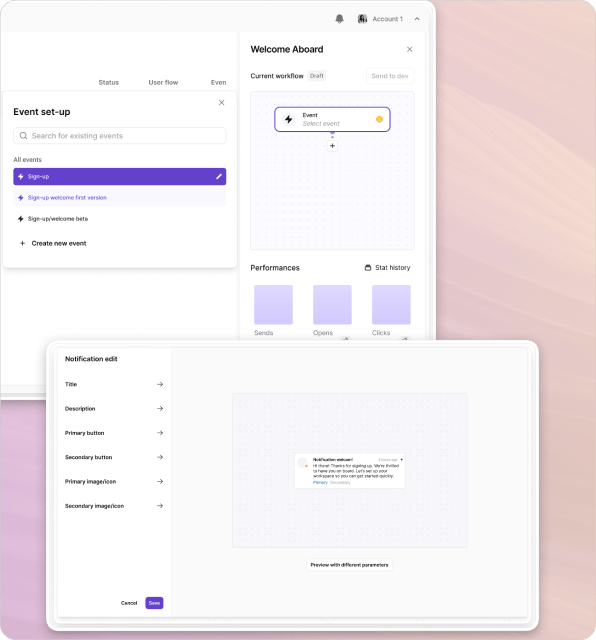
Ownership and cross team collaboration
In traditional messaging tools, ownership can become informal. Marketing creates campaigns, product reviews occasionally, and developers intervene when needed.
Notifizz formalizes collaboration between growth, product, and engineering. Each notification has a defined status and clear responsibility. This structured alignment prevents bottlenecks and miscommunication.
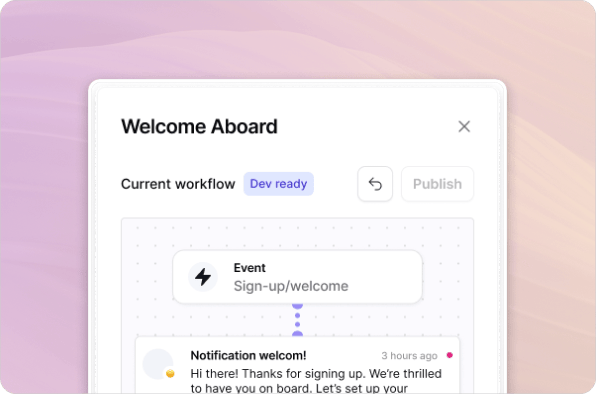
Visibility into what is actually live
One of the most common internal questions is simple: what notifications are currently live? In complex messaging setups, answering that question can require digging through multiple campaigns.
Notifizz centralizes visibility in a single system view. Teams can audit live notifications in seconds. This transparency directly improves confidence and operational clarity.
Choosing the right tool for your goals
If your primary need is customer support and conversational messaging, Intercom remains a strong option. If your challenge is managing in-app notifications as product components, structure becomes critical.
Notifizz is designed specifically for that use case. The decision ultimately depends on whether you see notifications as messages or as product infrastructure.
Related articles
Notification fundamentals·AI AuthorProduct-led notifications: how your product should communicate for itself
Notifications aren't marketing afterthoughts. In product-led companies, they're core product surfaces that should reflect real product state and user context.
Read more
Publishing and governance·AI AuthorHow to measure the business impact of your notification campaigns
Move beyond open rates to track real business outcomes like activation, payment recovery, and upgrade conversion through goal-aware campaign design.
Read more
Notification fundamentals·AI AuthorNotification segmentation: targeting the right user at the right moment
Learn how to use live business data and eligibility logic to send notifications to the right users at exactly the right moment, without relying on stale audience segments.
Read more
Notification fundamentals·AI AuthorRevenue notifications: upsell and payment recovery done right
How to build effective revenue notifications that recover payments and drive upgrades without overwhelming users or continuing after goals are reached.
Read more
Activation and onboarding·jeremie campariHow product notifications drive user activation (with examples)
Product notifications can make the difference between users who discover value and those who churn. Learn how to design activation sequences that respond to real user behavior.
Read more
Notification fundamentals·jeremie campariRetention notifications that work: timing, context, and relevance
Learn how to build effective retention campaigns with behavioral triggers, fresh business context, and coordinated timing that prevents churn without overwhelming users.
Read more
Activation and onboarding·jeremie campariUsing notifications to reduce churn before it happens
Turn product usage events into proactive retention campaigns with fresh business context at execution
Read more
Notification fundamentals·jeremie campariMulti-Channel Notification Strategy: When to Use Push, Email, and In-App
Learn how to choose the right notification channel for each message and build a cohesive multi-channel strategy that increases engagement without overwhelming users.
Read more
Publishing and governance·jeremie campariWhat it means to publish with intention
Publishing a notification should never be a casual action. Every message that goes live affects user experience, product clarity, and brand perception.
Read more
Notification UX·jeremie campariNotification bell UX: why it works
The notification bell is one of the most recognized icons in digital products. Simple, familiar, and effective, it has become a standard entry point for in-app communication.
Read more
Event based notifications·jeremie campariEvent based notifications: the complete guide
Event based notifications are not just smarter, they are more respectful of user behavior. Instead of interrupting randomly, they respond to real actions and real intent.
Read more
Activation and onboarding·jeremie campariHow to increase activation with in-app notifications
Activation is won or lost in the first key moments of product experience. The right notification, delivered at the right time, can move users from curiosity to commitment.
Read more
Notification fundamentals·jeremie campariWhy your in-app notifications create more confusion than engagement
In-app notifications are meant to guide users, not overwhelm them. Yet in many products, they accumulate without structure, ownership, or clear intent.
Read more