
Notifications rarely exist alone
A notification is never isolated. It reacts to an event, targets a specific audience, appears in a defined context, and competes with other messages. Yet most teams design them one by one without considering the broader system they create together.
Over time, this fragmented approach leads to overlap and inconsistency. Users receive multiple prompts that feel disconnected or repetitive. What was meant to guide them starts to feel like noise.
The visibility gap inside teams
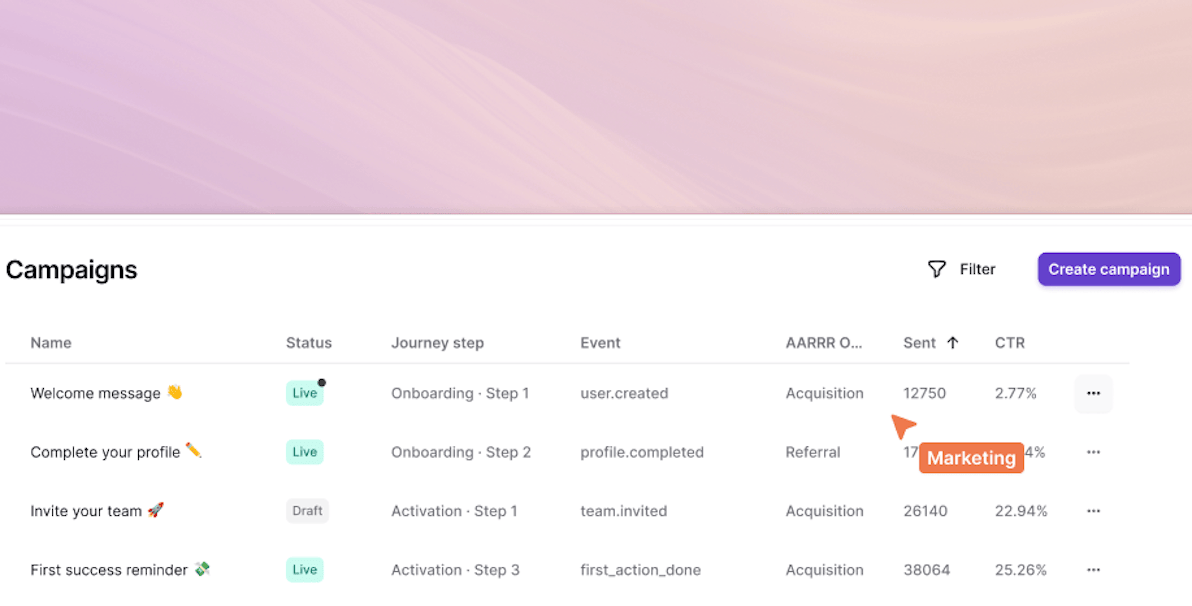
In many companies, no one can clearly list every notification currently live in the product. Some were launched during a growth experiment, others added for a feature release, and a few quietly forgotten. Without a centralized view, teams rely on memory, Slack threads, or scattered documentation.
This lack of visibility makes it hard to understand what users are actually seeing. When teams are unsure, users inevitably feel that confusion.
Messages without a clear intention
An effective notification should answer a simple question: why does this exist? Is it meant to activate, educate, retain, or convert? Too often, notifications are created reactively, triggered by short term goals rather than long term experience design.
Without a clear intention, they interrupt rather than assist. Users quickly learn to ignore messages that do not provide obvious value.
Accumulation turns into product debt
Notifications accumulate silently over time. Rarely deleted, frequently edited, and sometimes duplicated, they form a hidden layer of product complexity. Each additional message increases cognitive load for users and maintenance burden for teams.
What started as a helpful nudge becomes an ecosystem of unmanaged prompts. This silent accumulation eventually reduces trust in the product experience.
When marketing, product, and engineering misalign
Notifications sit at the intersection of marketing goals, product logic, and engineering constraints. If these teams do not share a clear process, ownership becomes blurry.
Marketing may not know what is technically live, product may not review messaging details, and developers may implement logic without context. The result is friction internally and inconsistency externally. Users experience that misalignment as confusion.
Designing notifications as a structured system
Engagement increases when notifications are treated as product artifacts rather than simple messages. Each notification should have a defined trigger, audience, status, and owner.
Teams should be able to audit what is live in seconds and review changes safely before publishing.
Clarity inside the organization translates directly into clarity for users. When notifications are designed intentionally, they guide behavior instead of distracting from it.

