Traditional notification systems rely on pre-built user segments that become stale the moment they're created. A user classified as "inactive" might have just completed a key action. An "overdue payment" segment might include customers who paid five minutes ago. This mismatch between static segments and dynamic business reality leads to irrelevant notifications and frustrated users.
Effective notification segmentation requires a different approach: targeting based on live business data at the moment of execution. Instead of asking "who was in this segment yesterday," teams need to ask "who should receive this notification right now, based on current business context."
Notifizz addresses this challenge by using enrichers to bring live business context into campaigns at execution time, combined with eligibility logic that continuously evaluates whether each recipient should continue receiving notifications as conditions change.
Why static segments fail for notification targeting
Most marketing platforms require teams to sync user data upfront and create segments based on historical snapshots. This approach creates several problems:
- Data staleness: Segments reflect past conditions, not current reality
- Sync delays: Important business changes take time to propagate to the marketing platform
- Maintenance overhead: Teams must constantly update segments as business logic evolves
- Cross-team coordination: Marketing depends on engineering to modify data pipelines for new targeting needs
The result is notifications that arrive too late, target the wrong users, or continue sending to users who have already completed the desired action. Static segmentation simply cannot keep pace with dynamic business operations.
Behavioral segmentation with live business context
Behavioral segmentation becomes more powerful when it operates on live business data rather than historical snapshots. Instead of categorizing users based on past actions, teams can evaluate current behavior and business context at the moment each notification is triggered.
Consider an onboarding campaign for users who haven't activated a key feature. Traditional segmentation would create a static list of "non-activated users" and send the same sequence to everyone on that list. But business reality is more nuanced:
- Some users may have activated the feature since the segment was created
- Others might be in a trial period that just expired
- Team accounts might need different messaging than individual users
- Users who recently received multiple notifications might need a communication break
Live behavioral segmentation evaluates these conditions in real-time, ensuring notifications remain relevant to each user's actual current state.
How enrichers enable precise targeting
Enrichers are Notifizz's solution for bringing live business context into notification campaigns without requiring heavy upfront data synchronization. These are reusable functions that fetch specific business information at campaign execution time.
When a campaign needs to determine who should receive a notification, enrichers can retrieve current business context such as:
- The account owner for a given organization
- Whether an invoice is still unpaid
- The current subscription status and plan level
- Whether a target feature has been activated since the campaign started
- The user's role and permissions within their workspace
Development teams create enrichers once, exposing business capabilities that marketing and product teams can then reuse across multiple campaigns. This spreads implementation effort over time instead of concentrating it in a large upfront data project.
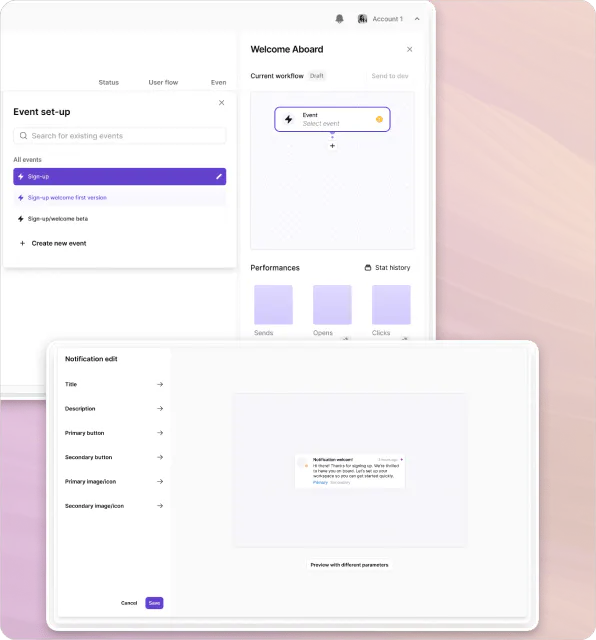
Eligibility logic: keeping targeting accurate over time
Eligibility logic determines whether a recipient should continue receiving notifications as a campaign progresses. Unlike static segments that remain fixed, eligibility logic continuously evaluates whether each user still belongs in the target audience.
This logic considers multiple factors:
- Goal completion: Users who complete the campaign objective are removed from future sends
- Business state changes: Users whose circumstances change mid-campaign are re-evaluated
- Communication pressure: Users receiving too many recent notifications may become ineligible for non-transactional messages
- Channel preferences: Users who opt out or bounce are excluded from affected channels
For example, a payment recovery campaign might continue sending reminders until the invoice is paid, at which point the eligibility logic removes that user from the remaining sequence. This prevents irrelevant "overdue payment" notifications from reaching customers who have already settled their accounts.
Coordination across notification categories
Different types of notifications require different targeting approaches. Notifizz separates notifications into distinct categories, each with appropriate eligibility rules:
Transactional notifications target users based on specific actions they've taken. A password reset notification targets the user who requested it. An invoice confirmation targets the person who made the purchase. These notifications cannot be opted out of and have the highest delivery priority.
Product notifications target users based on their relationship with product features and their usage patterns. An activation campaign might target users who haven't completed onboarding, while a feature announcement targets users whose plan includes the new capability.
Marketing notifications target users based on business opportunity and engagement history. These require explicit consent in many jurisdictions and always include opt-out mechanisms.
Proper category separation ensures each notification type follows appropriate targeting rules and delivery practices, maintaining both compliance and user experience standards.
Real-world targeting scenarios
Consider how live business context improves targeting in practice:
Overdue invoice reminders: Instead of sending to a static "overdue accounts" segment, enrichers check current payment status at each send. Users who pay between reminder steps are automatically removed from the sequence.
Feature activation campaigns: Rather than targeting "users who signed up 7 days ago," enrichers evaluate current activation status. Users who activate the feature mid-campaign stop receiving activation reminders and might start receiving advanced usage tips instead.
Upgrade prompts: Instead of sending upgrade notifications to all "free plan users," enrichers can check current usage patterns, plan limits, and recent billing interactions to identify users most likely to benefit from an upgrade conversation.
In each case, targeting decisions happen at execution time based on current business reality, not historical snapshots.
Building sustainable targeting practices
Effective notification segmentation requires balancing precision with maintainability. Notifizz's approach spreads implementation effort over time by creating reusable business capabilities rather than rebuilding targeting logic for each campaign.
Development teams focus on exposing clean business context through enrichers. Product and marketing teams can then combine these capabilities to create targeted campaigns without requiring new development work for each targeting need.
The notification review space allows teams to validate targeting logic before going live, ensuring notifications reach the intended audience with appropriate context and timing. This human-in-the-loop approach prevents targeting mistakes while maintaining campaign velocity.
By anchoring targeting decisions in live business data rather than static segments, teams can deliver notifications that remain relevant and valuable throughout each user's journey, improving engagement while reducing communication overhead.

