Most SaaS notifications feel like marketing interruptions. They arrive at the wrong time, with stale information, disconnected from what users are actually experiencing in the product. This happens because notifications are treated as a marketing channel instead of what they really are: product surfaces.
In product-led growth companies, notifications should work differently. They should reflect real product state, respond to actual user behavior, and feel like natural extensions of the in-product experience. This isn't about sending more messages. It's about making every notification feel like it belongs.
Notifizz approaches notifications as product artifacts first. Instead of building campaigns around synced user profiles, teams build campaigns around live business context that stays connected to the real product journey.
What makes a notification product-led
Product-led notifications share three characteristics:
- Fresh context at execution: The notification reflects the user's current product state, not a snapshot from hours or days ago
- Product-aware timing: Messages arrive based on actual product events and user actions, not arbitrary schedules
- Goal-oriented completion: The notification journey ends when the product goal is achieved, preventing irrelevant follow-ups
Traditional marketing automation works backwards from synced user segments. Product-led notifications work forward from product events, bringing in the business context needed to make each message relevant and timely.
The enricher approach to fresh context
The core challenge in product-led notifications is accessing the right business context when a notification executes. User segments become stale. Event payloads often lack crucial details. Teams end up building custom sync processes or accepting outdated information.
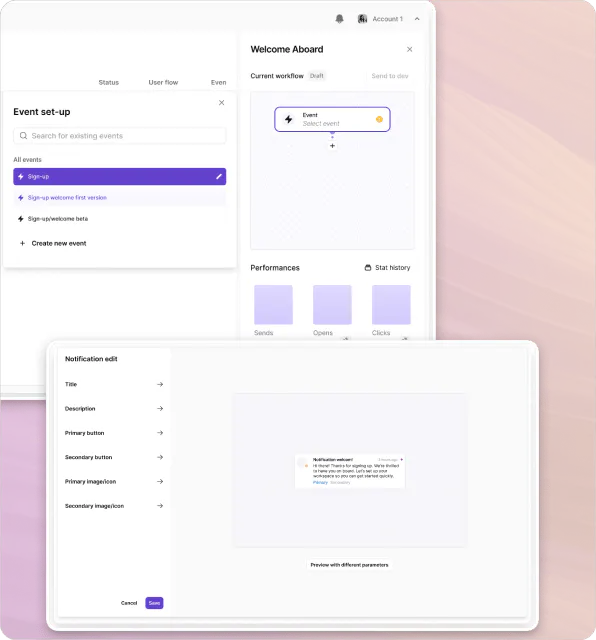
This is where Notifizz's enricher system creates a meaningful advantage. Instead of working with stale synced data, enrichers bring fresh business context right when the notification executes through customer-specific business lookups that teams implement once and reuse across campaigns.
For example, when a payment fails, the initial event might only contain a user ID and transaction ID. An enricher can add the account context, billing history, and workspace details needed to send a relevant recovery message to the right person with the right information.
This keeps notifications connected to current product state instead of yesterday's data snapshot.
In-app messaging as the primary channel
Product-led notifications start in-product. Email and push are secondary channels for when users aren't actively engaged. This hierarchy matters because in-app messages can leverage immediate product context that external channels can't access.
Notifizz includes a native notification center that feels like part of the product, not a separate messaging system. Users see notifications that connect directly to their current workspace, project, or task context. This makes the notification experience consistent with the rest of the product journey.
External channels like email work best for bringing users back into the product when they've been away, or for important updates that can't wait for the next login. But the primary notification experience should happen where users are already engaged with your product.
Campaign structure that stays readable
Product-led notifications need to stay maintainable as products evolve. Complex workflow builders create campaigns that become impossible to review, update, or hand off between team members.
Notifizz keeps campaigns linear by design. One campaign equals one focused sequence with one clear objective. Instead of building branching workflows, teams create multiple focused campaigns that each solve one specific product communication need.
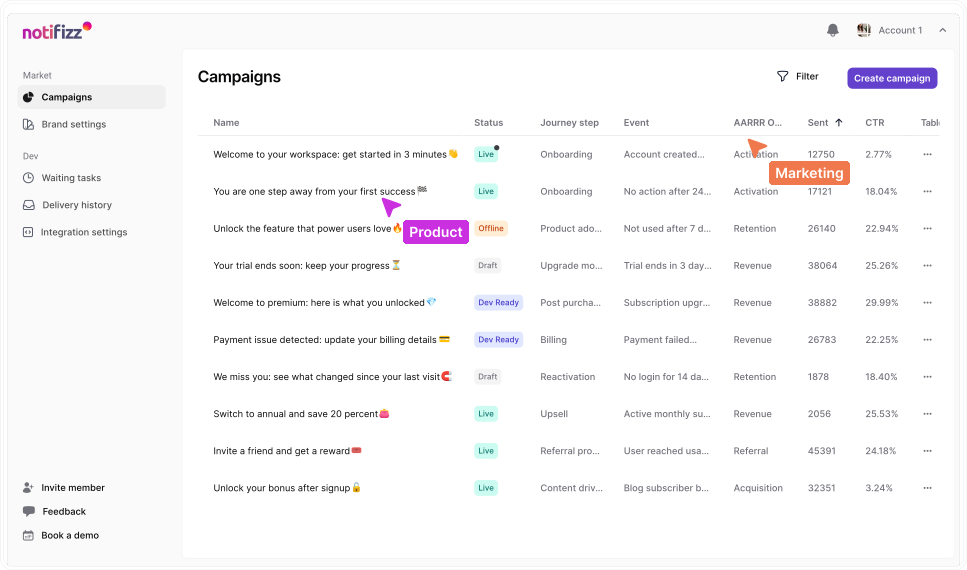
This approach supports powerful notification journeys through enrichers, timing logic, goal events, and eligibility rules, but keeps each campaign readable in one click. Product managers can review what's live, developers can understand the business logic, and marketing can launch campaigns without getting lost in workflow complexity.
Cross-team collaboration on the same system
Product-led notifications require coordination between product, engineering, and marketing teams. Each team contributes different capabilities, but they need to work on the same notification infrastructure to avoid duplicated effort and inconsistent user experiences.
Notifizz includes notification pressure management. Instead of maximizing message volume, the system helps teams coordinate by measuring how much communication a user is already receiving, helping prevent overloading users with too many messages.
The notification review space lets teams inspect notifications from non-production environments before launch, catching rendering issues, logic problems, and experience inconsistencies without sending test messages to real users.
Building notifications that scale with product complexity
As products grow more sophisticated, notification requirements become more complex. Product-led companies need notification systems that can grow with product complexity without becoming unmanageable.
This means treating notifications as first-class product capabilities, not as loose messages scattered across tools. Teams should be able to review what notification experiences exist, understand what's currently live, and design new campaigns that stay consistent with the overall product experience.
Notifizz supports this through reusable sections across channels, campaign workflow states that support human review, and category separation that keeps transactional, product, and marketing communications properly organized.
Product-led notifications aren't about sending more messages. They're about making every message feel like a natural extension of the product experience, delivered with fresh context, at the right time, through the most appropriate channel.

